
Using Knees and Hips for Improved Off-Road Motorcycle Control
Aug 04, 2022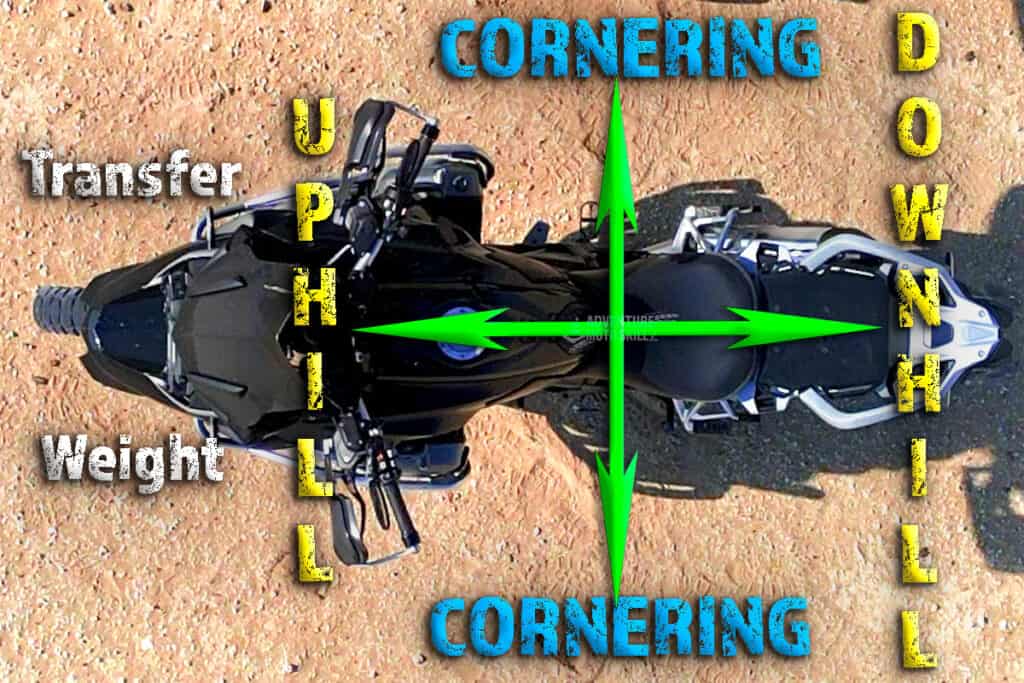
By Coach Mike, ADVMotoSkillZ
The importance of using knees and hips to control your bike during standing riding cannot be overstated. Many riders make the mistake of using only their arms to steer and control the bike; this leads to fatigue and poor control. By using your knees and hips to guide the motorcycle, you’ll be able to stay balanced and upright in even the most difficult terrain. Let’s look at some examples:
| Riding Scenario | Knee Posture | Hips Posture |
|---|---|---|
| Neutral Standing Posture | Close to seat with slight bend | Centered over pegs |
| Accelerating (standing) | Gentle squeeze of seat or tank | Transfer forward |
| Decelerating (standing) | Firm squeeze of seat or tank | Transfer rearward |
| Hill Climb (standing) | Gentle squeeze of seat or tank | Transfer forward |
| Hill Descent (standing) | Firm squeeze of seat or tank | Transfer rearward |
| Cornering (standing) | Outside knee pushes into tank Inside knee hooks the seat | Transfer to the outside |
| Uphill Cornering with Speed (standing) | Firm squeeze during straightaway, then transition into cornering posture | Transfer forward and to the outside |
| Downhill Cornering (standing) | Firm squeeze during straightaway, then transition into cornering posture | Transfer rearward and to the outside |
| Rocky Terrain (standing) | Firm squeeze of the seat or tank Bend as needed to absorb bounces | Transferring up and down, acting as shock absorber |
| Water Crossing (standing) | Firm squeeze of the seat or tank | Transferring in all directions as river bed demands |
This post may contain affiliate links. Please see our Privacy & Disclosure Policy for more details.
In this article, we’ll discuss how to use your knees and hips properly to navigate through these terrains and riding situations. By the end of this article, you will have the knowledge you need to become a more confident rider.
If you missed our post “Foot Position for ADV Motorcycles Off-Road: A Detailed Guide”, then click here to review the importance of having a solid foundation at the feet and pegs before moving up to the knees and hips.
Innovative Motorcycle Tool Sets – Compact & Reliable
Used and recommended by ADVMotoSkillZ
Visit SBVTools Here
Knee placement on an off-road motorcycle when standing
Off-road motorcycle riding offers varied and uneven terrain that requires constant rider input. Our knees are one opportunity to increase control and stability of the bike during bumps and corners.
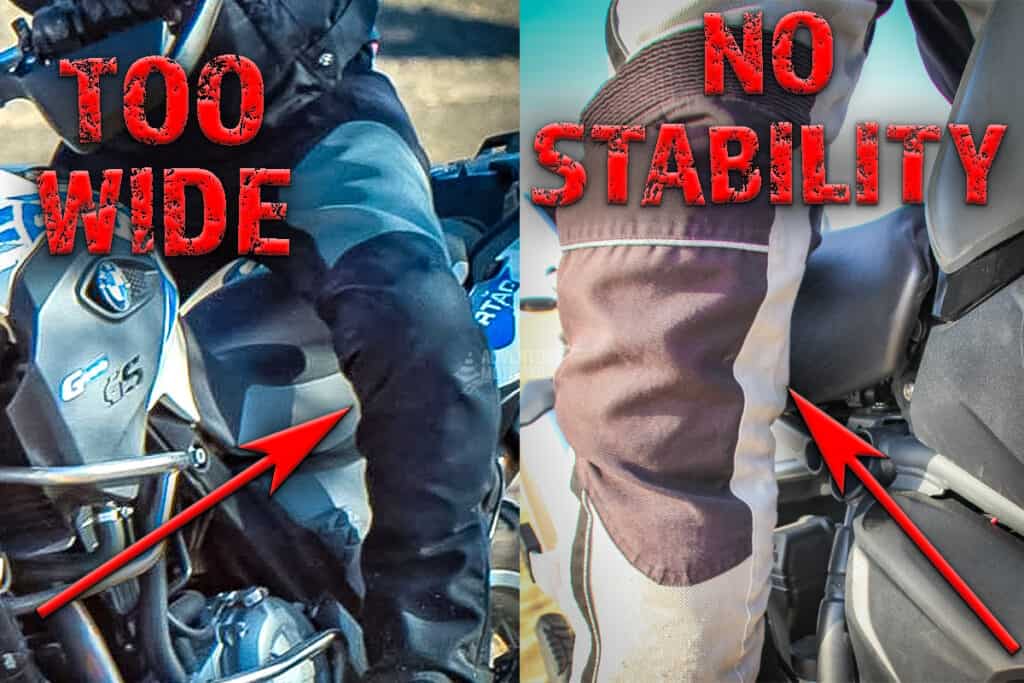
Take a look at the picture below to see an example of a faulty wide-knee standing riding posture. Riding off-road with wide knees like this creates a few disadvantages. Firstly, the hands and feet are now the only attachment points between rider and bike; this means the upper body will need to provide the majority of steering and control input. Overworking the arms and hands in this way can lead to exhaustion and increase the risk of injury.
Examples of poor knee positioning when riding off-road
Secondly, wide knees create an unstable base and increase the chances of falling over during rocky or bumpy sections. When the front tire is hitting tree roots or dips in the terrain, the bike will bounce around and slap the inside of the knees leading to loss of balance. Lastly, wide knees are a hazard during narrow off-road trails when they could hit hanging tree branches or other obstacles.
Has this ever happened to you? You are riding down a section of trail and suddenly everything starts to feel out of control. The bike is tipping and swaying uncontrolled underneath you. Your natural reaction is to try and make it stop! It goes something like this:
An aggressive rolling off of the throttle, creating the exact same effect on the bike as quickly squeezing the front brake. Then the abrupt loss of momentum causes the front suspension to dip, which can then overload the front tire. Combine this with the inevitable death grip on the bars that further stiffens and limits steering inputs. We are left with no momentum and limited steering availability ... and here comes the tip-over we were trying to avoid.
So what can we do instead? Proper standing riding posture should include knees that are constantly engaged in the action. They may begin stacked directly over the pegs but are frequently squeezing and releasing the inner portion of the seat and/or tank. It is this squeeze point at the knees that allows for some of the most significant rider input to the bike. With the knees doing this much work, your upper body can remain light on the handlebars and your adventure can last much longer.
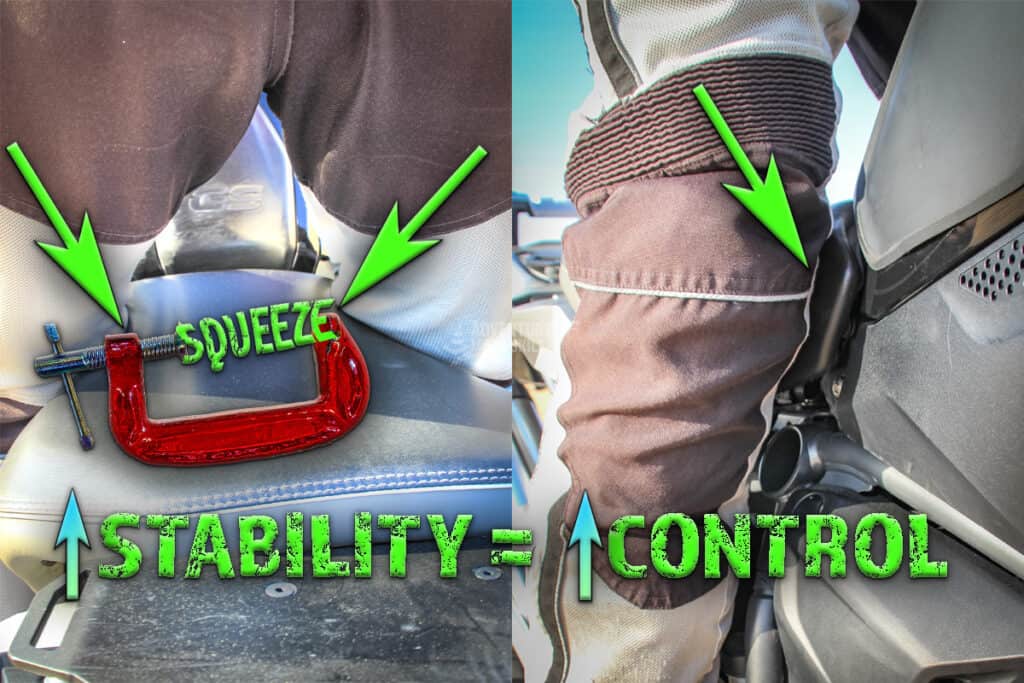
During cornering off-road, the outside knee will be fully engaged and pushing into the tank as you counterbalance and lean the bike into the turn. The inside knee will hook the edge of the seat as you are coming around the corner for added stability. The amount of counterbalance and knee pressure needed on any particular corner will be decided by your speed, arc of the turn, and bike/rider size.
Be sure to use flat straightaways to stand tall and relax your legs whenever you can.
Using the hips to counterbalance and control the bike
Approximately 60% of our body weight lies above the hips (reference). By actively positioning and repositioning our hips during off-road riding, we direct our body weight to influence the trajectory of the bike. This is particularly critical during counterbalancing for corners and maintaining balance on rocks, jumps, and hills.
When riding down a trail, we are constantly using our vision to assess the terrain ahead and then reacting with body posture adjustments and bike control inputs to best prepare for the next challenge. Hip positioning during these transitions dictates how our body weight communicates with the bike.
Watch: using hip movement to improve control of the motorcycle
In our video, we can see some examples of hip movements that are so impactful to our riding. Let’s consider some examples:
Steep Hill Climb – During a hill climb, gravity and momentum combine to naturally push our body weight rearward. To counteract this, we transition the hips forward just as we approach the hill to place more weight on the front tire for better traction and balance. If the hill is particularly long or steep and you are losing traction, then you may need to transfer hips rearward near the top of the climb.
Steep Hill Descent – Similarly, a hill descent will force our body forward due to the angle of the bike and gravitational forces. During a steep downhill, we want more weight on the rear tire to avoid overloading the front end. This more optimal posture is achieved by transitioning the hips rearward (as far as possible) as we crest and go downhill.
Rocky or rutted terrain – Some off-road trails can get pretty bumpy despite the most state-of-the-art bike suspension systems. Ease the impact of these bumps by transitioning your hips up and down to act as a second set of shock absorbers. As you feel the bike come up or drop down, adjust the depth of your squat posture from the hips and knees to create a more comfortable ride and improve balance control.

Top-quality gear for your next adventure
Used and recommended by ADVMotoSkillZ
Visit Lone Rider Here
Creating balance on your motorcycle with lower body posture
As you practice using your knees and hips more efficiently out on the trails, you will soon be feeling the synergy of having the whole lower body moving together. If you would like to review some key components of foot-on-peg placement, then check out our Foot Positioning post here. With each ride, you will feel the hips, knees, and feet working together to improve your bike control.
Cornering body posture
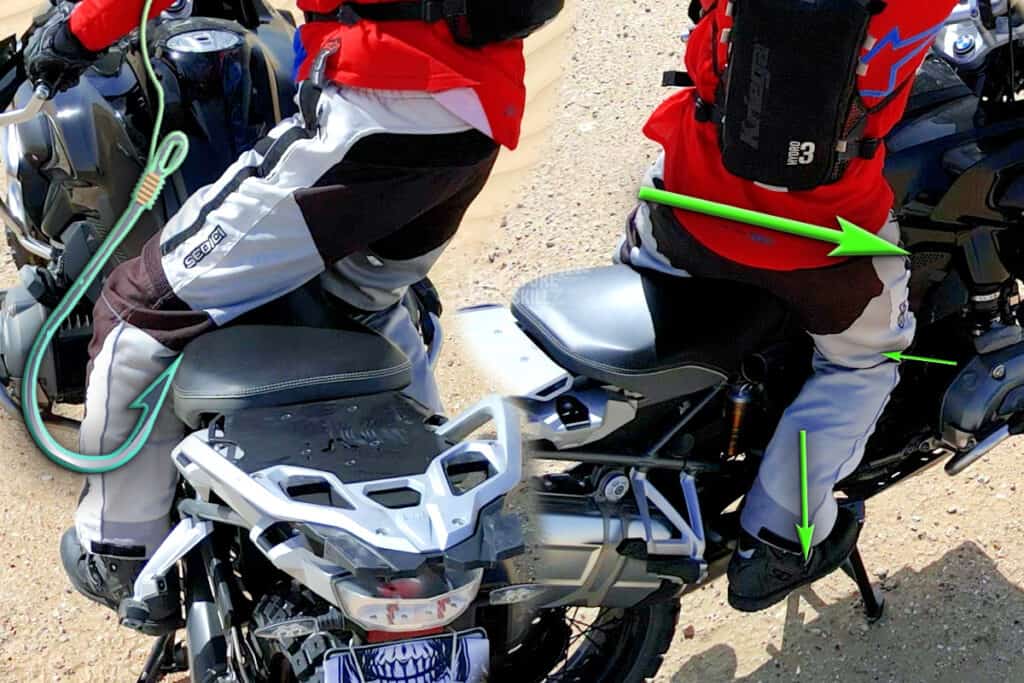
See above how the synergy of the lower body looks during cornering. Off-road cornering is performed by leaning the bike into a curve while counterbalancing to the outside of the corner. The hips transition to the outside to bring the body weight over the outside peg. The outside knee presses into the tank, while the inside knee hooks the edge of the seat. Together, these postures combine for a successful and controlled off-road corner.
Protecting knees and hips during adventure motorcycle riding
Knee and hip protection is must-have gear as an ADV off-road motorcycle rider. This protection can be built into riding pants or can be worn under your pants. Personally, I prefer to wear Knox Trooper MK3 Shorts and Knox Knee Guards under my Sedici mesh riding pants.
This gear always remains in place and moves comfortably with my body through the gnarliest of riding trails. Tips and falls are inevitable when riding off-road, so I truly appreciate the peace of mind that this high-quality protective gear gives me.
Want feedback on your knee and hip positioning?
Film a few standing sections of your next ride and send them to me through ADVMotoSkillZ Video Coaching. I’ll look at how your knees and hips are working with the bike and give you drills to improve your control. Based in the UAE? Book in-person off-road coaching instead.
Originally published 4 August 2022 by Coach Mike, ADVMotoSkillZ.
Author


